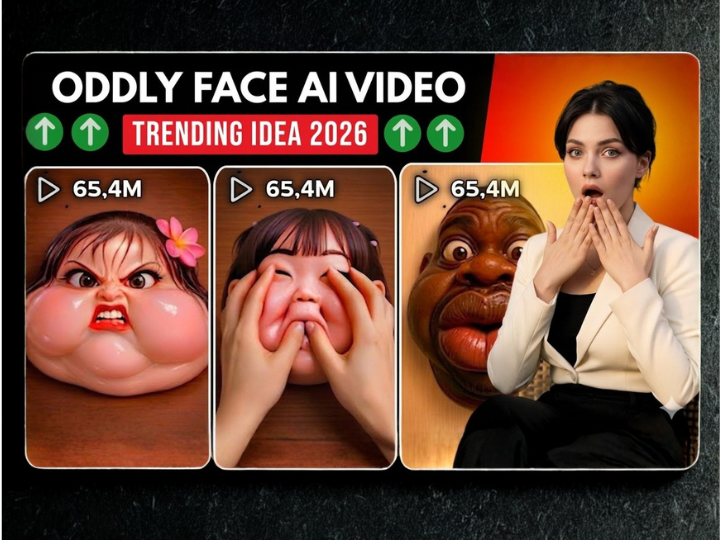
Generate your first jelly face ASMR clip free with AI — no camera, no microphone, no editing experience.
Try OpenArt AI Free →Free credits to start · Generate images & video from one dashboard
If you've been scrolling TikTok or Reels lately, you've probably stopped mid-scroll for a video of a glossy, wobbling, translucent face getting squished, poked, or stretched like gelatin. Jelly face ASMR is one of the fastest-growing faceless AI video trends of 2026, and the entire thing — face, texture, hands, motion — is generated with AI. No camera, no microphone, no studio. This guide walks through exactly how it's made, the prompts that actually work, and the free tools to get started today.
This covers what jelly face ASMR is, why it's going viral, the exact AI workflow and prompts used to create it, the best free tools, and how to turn it into a consistent faceless content channel.
Jelly face ASMR is a visual-ASMR trend where an AI-generated face is rendered with a glossy, wet, translucent "jelly" texture, then animated being squished, poked, or stretched by a pair of hands in a slow, satisfying motion. The appeal is entirely tactile — viewers can't literally touch the screen, but the visual mimics the sensation so convincingly it triggers the same relaxation response as traditional ASMR. It's part of a broader wave of AI ASMR content (glass fruit slicing, kinetic sand cutting, jelly cakes) that's pulling in millions of views without a single frame of real footage.
Three things make this format spread fast. First, the texture illusion — glossy, wet, jiggling surfaces are inherently satisfying to watch, a well-documented ASMR trigger. Second, the pattern interrupt — a face (sometimes stylized to resemble a recognizable expression or character) rendered as jelly is surreal enough to stop a scroll instantly. Third, it's a faceless format — creators don't need to appear on camera, record audio, or own any equipment, which means anyone with a laptop or phone can start a channel from zero.
The process comes down to three stages: generate the base jelly face image, animate it into a short video clip, then edit and add sound. Here's the breakdown creators are actually using right now.
Step 1 — Generate the base jelly face image. Use an AI image generator to create a hyper-realistic gelatinous face texture on a plain or marble background. The key is being extremely specific about the material — "jelly" alone won't get you the glossy, translucent result that makes the trend work.
Step 2 — Animate the squish motion. Feed your generated image into an AI video generator and prompt for the hand movement and material physics. This is the step that turns a static image into the satisfying "squish" loop viewers scroll to see.
Step 3 — Edit and add sound. Cut your clips to a rhythm — each squish should last about 3–5 seconds, with hard cuts between angles or faces to keep energy up. Layer in ASMR-style squish and tap sound effects, or a trending audio track, then export vertically at 1080×1920 for Reels, TikTok, and Shorts.
You don't need an expensive setup to start. A free-tier AI image generator handles the base face texture, and a free-tier AI video generator animates the motion. OpenArt is one of the easiest starting points for this workflow since it combines image generation, video animation, and prompt templates in one dashboard, so you're not jumping between three separate tools to finish a single clip.
| Stage | What You Need | Free Option |
|---|---|---|
| Base jelly face image | AI image generator with strong texture rendering | Free daily credits on most platforms |
| Animate the squish motion | Image-to-video AI generator | Free-tier video credits, limited clip length |
| Cut, sound, export | Basic video editor (CapCut or similar) | Free, no watermark on most mobile editors |
The jelly face niche is getting crowded fast, so the creators pulling real views are the ones twisting the base concept rather than copying it exactly. A few directions worth testing:
Fruit-filled jelly: Swap a plain gelatin texture for translucent jelly with fruit slices suspended inside, catching the light as hands press into it.
Color and material swaps: Try iridescent, holographic, or color-shifting jelly instead of clear gelatin to create a more unique visual signature for your channel.
Unexpected objects: Apply the same jelly-texture technique to everyday objects — keyboards, fruit, household items — instead of faces, which keeps your content feed varied while staying in the same satisfying-texture niche.
Hook viewers in the first second — lead with the most visually satisfying squish, not a slow build-up. Use trending ASMR and satisfying-content hashtags, post consistently (daily or every other day tends to perform best for faceless AI channels), and disclose AI use where required by the platform. Some faceless AI ASMR channels have reportedly reached over 150,000 subscribers in under three months using this exact workflow, so consistency matters more than production complexity here.
Can I make jelly face ASMR videos for free?
Yes — free tiers of AI image and video tools are usually enough to test the trend before you need to upgrade for higher resolution or longer clips.
What AI tools are used for jelly face ASMR videos?
An AI image generator creates the base jelly-textured face, an AI video generator animates the squish motion, and a free mobile editor handles cutting and sound.
Why are jelly face ASMR videos going viral?
The combination of a satisfying glossy texture and a surreal, expressive face creates a strong sensory response and a scroll-stopping pattern interrupt.
Do I need to show my face to make AI ASMR videos?
No — it's a fully faceless format generated entirely from text prompts, with no camera, microphone, or filming equipment required.
Jelly face ASMR is one of the lowest-barrier viral content formats going right now — no camera, no editing background, no studio, just detailed prompts and a couple of free AI tools. If you're building a faceless content channel or testing new formats for an existing one, this is worth a real attempt this week while competition is still relatively low.
Start generating your first jelly face ASMR clip free with OpenArt →
Written by David Chen
David covers AI tools, faceless content workflows, and viral video trends for Startuplexa, testing prompts and platforms before publishing a guide. Have a correction or update? Contact us.

This really encouraged me today, thank you for sharing!
Beautifully written. Sharing this with my family.
Exactly what I needed to read right now. Bless you for this.